 Gay Timeline
Molly Houses: The Secret Gay Taverns of Georgian London
The short answer. Molly houses were the taverns, coffee houses and private rooms where gay men met in eighteenth-century London. They were the gay bars of their day, complete with nicknames, dancing, in-jokes and mock weddings, at a time when sex between men carried the death penalty. The most famous, Mother Clap’s in Holborn, was raided in February 1726. Three men were hanged at Tyburn that May.
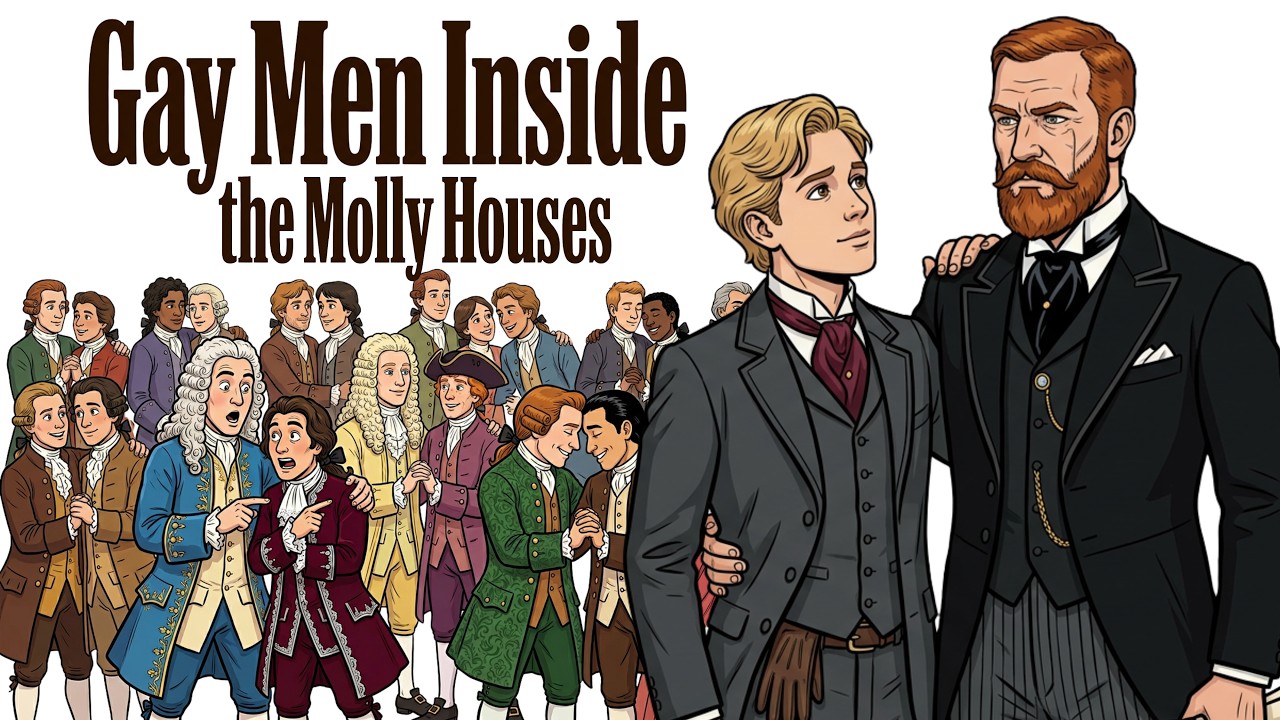
What a molly house was
Picture London in the 1720s. It is the largest city in Europe, crowded, noisy and anonymous in a way no English town had been before. A young man could arrive from the country, take a room, find work as a footman or an upholsterer’s apprentice, and for the first time in his life be unknown to everyone around him.
For men who desired other men, that anonymity made something new possible. They could find one another. And once they had, they needed somewhere to go.
A molly house was that somewhere. Usually it was the back room of a tavern or alehouse, sometimes a coffee house, sometimes simply a private home whose keeper was friendly and sold drink. There was no sign over the door. You heard about it from someone who trusted you.
It is tempting to call them brothels, and their enemies did. Most historians now think that is wrong. Rictor Norton, whose book Mother Clap’s Molly House is the standard account, points out that there is little evidence of men being paid for sex in these houses before the 1780s. The customers were regulars who knew each other. What the houses sold was ale and privacy.
Where the word “molly” comes from
“Molly” is a pet form of Mary. In the slang of the time it could mean a working-class woman or a prostitute, and by the early 1700s it had become the common word for an effeminate man who loved men. Some have linked it to the Latin mollis, meaning soft, though the simpler explanation is probably the right one.
What matters is that the men used it of themselves. That is a small fact with large implications. A century and a half before anyone coined the word “homosexual”, there were men in London who had a name for what they were, a set of places to be it, and a way of talking that marked them as belonging. Historians call that a subculture. It is one of the earliest we can document anywhere in Europe.
What happened inside
Our best descriptions come from hostile witnesses, men who went in as spies and then testified in court. Read past the disgust and what they describe is recognisable to anyone who has ever walked into a gay bar.
- Maiden names. Regulars went by female nicknames. A contemporary list includes “Ellinor Roden” and “China Mary”. The names often came from a man’s trade, his home town or some private joke.
- Singing and dancing. Witnesses describe fiddles, country dances and bawdy songs, with men calling each other “my dear” and sitting in one another’s laps.
- “Marrying.” Couples who wanted privacy went to a back room. The mollies called this marrying, and in some houses the room was known as the chapel. Sometimes there was a mock ceremony first.
- Mock births. The strangest ritual, described by the satirist Ned Ward around 1709: on festival nights, one man in a nightgown would pretend to give birth, attended by friends playing midwives, and a wooden doll would be produced and christened. It sounds bizarre. It was also a group of outcasts inventing their own carnival, and laughing at the family life they were shut out of.
Above all, the trial records describe men who were at ease. For a few hours on a Sunday night, they could stop watching themselves.
Mother Clap’s house in Field Lane
The best known molly house was kept by Margaret Clap, known to everyone as Mother Clap. From about 1724 she ran a coffee house in Field Lane, Holborn, a rough street a short walk from the City of London. It was almost certainly her own home.
By the standards of the trade it was a large and comfortable place. A witness testified that she kept “beds in every room of the house” and that she had “thirty or forty of such kind of chaps every night, but more especially on Sunday nights.” She did not sell drink herself, since she had no licence, but fetched it from a tavern across the road.
What stands out in the record is that she seems to have liked her customers. She let men lodge with her. On one occasion she went to court and gave false evidence to get a man acquitted of a sodomy charge. When her own turn came, she did not inform on anyone.
The raid of 1726 and the men who were hanged
London at this time had a private morality police. The Societies for the Reformation of Manners were associations of pious citizens who paid informers and brought prosecutions against brothel keepers, Sunday traders and, increasingly, mollies.
They had been watching Field Lane for about two years. Their way in was a man named Mark Partridge, who had quarrelled with his lover and been exposed. To save himself, he agreed to take the Society’s agents into the molly houses, introducing each constable as his “husband”. One of those agents, Samuel Stevens, later gave the court a detailed account of what he had seen.
On a Sunday night in February 1726, constables raided Mother Clap’s. About forty men were arrested and taken to Newgate. Over the following weeks more houses were raided across the city.
Most of those arrested were released for lack of evidence. A conviction for sodomy required proof of the act itself and two witnesses, which was hard to obtain. But the informers supplied it in several cases. On 9 May 1726, three men were hanged at Tyburn:
- Gabriel Lawrence, aged 43, a milkman and a widower with a daughter. Neighbours came to court to speak for his good character.
- William Griffin, aged 43, an upholsterer who had lodged at Mother Clap’s for nearly two years.
- Thomas Wright, who kept a molly house of his own.
Margaret Clap was tried that July for keeping a disorderly house. She was sentenced to stand in the pillory at Smithfield, to pay a fine of twenty marks and to serve two years in prison. The crowd at the pillory treated her so brutally that she fainted several times and fell from it once. After that she vanishes from the record. Nobody knows whether she survived her sentence.
One bitter footnote. Charles Hitchen, a former Under City Marshal who had worked with the reforming societies, was himself convicted the following year of an attempted sodomy. The line between the hunters and the hunted was never as clear as the hunters claimed.
After 1726: Vere Street and the long aftermath
The raids did not end the molly houses. They simply taught them to be more careful. Prosecutions continued through the century, and in 1810 the pattern repeated almost exactly at the White Swan in Vere Street, where a raid led to men being pilloried before enormous, violent crowds and two being hanged. That story is told in the library as “Inside the Secret Male Brothel of Vere Street: London, 1810”.
The law itself outlasted everyone in this story. The Buggery Act of 1533 had made sodomy a capital crime in England, and it stayed one until 1861. The last two men executed for it, James Pratt and John Smith, were hanged outside Newgate in 1835. Even after the death penalty went, the 1885 law against “gross indecency” sent thousands more to prison, Oscar Wilde among them, and later destroyed Alan Turing. Both appear in our list of famous gay men in history.
And yet the thing the mollies built was never stamped out. Every bar, club and back room that came after them is a descendant of those houses in Holborn and Moorfields.
How we know any of this
Here is the uncomfortable part. Almost everything we know about the mollies comes from the people who wanted them dead.
The main source is the Proceedings of the Old Bailey, the published accounts of trials at London’s central criminal court, now digitised and free to search online. Alongside them are satires like Ned Ward’s and pamphlets written to shock. No molly left a diary that we know of. Their voices reach us only as quoted by informers.
That is true of most gay history before the twentieth century. Ordinary men left no record of their private lives unless they were arrested. It is why our own stories at Gay Timeline lean so heavily on court files and trial transcripts, and why some of them follow a composite character built from several real cases, which we always say when we do.
The molly house story is gripping, and it is not a gentle one. If you are looking for something to play at night, our guide to gay history for sleep suggests calmer places to start.
Hear it told in full
“Inside the Molly Houses of Georgian London, 1726” is one of 100+ true stories in the Gay Timeline library. The first 3 minutes of every story are free.
Questions people ask
What was a molly house?
A molly house was a tavern, coffee house or private room in eighteenth and early nineteenth-century Britain where gay men met to drink, socialise and find partners. They were most common in London.
Why were they called molly houses?
“Molly”, a pet form of Mary, was the everyday slang word for an effeminate or homosexual man in the 1700s. The men used the word for themselves.
What happened at Mother Clap’s molly house?
Margaret Clap’s house in Field Lane, Holborn, was raided in February 1726 after two years of surveillance. About forty men were arrested. Three, Gabriel Lawrence, William Griffin and Thomas Wright, were hanged at Tyburn on 9 May 1726. Clap was pilloried, fined and imprisoned.
Were molly houses brothels?
Mostly not. Historians such as Rictor Norton find little evidence of paid sex in them before the 1780s. They were social meeting places whose keepers made money selling drink.
Was being gay punishable by death in England?
Sodomy was a capital crime in England from the Buggery Act of 1533 until 1861. The last executions were in 1835.
Where can I read the original trial records?
The Proceedings of the Old Bailey are digitised and free to search at Old Bailey Online. Rictor Norton’s book Mother Clap’s Molly House collects and explains the key cases.
How this article was made
Written by the Gay Timeline team, who research and produce the stories in our library. We drafted it with the help of AI writing tools and checked the facts against published sources before publishing. Where historians disagree, we have said so. Last reviewed 11 November 2026.
Sources and further reading: Rictor Norton, Mother Clap’s Molly House: The Gay Subculture in England, 1700–1830; The Proceedings of the Old Bailey; Molly house and Margaret Clap (Wikipedia); London Museum on molly houses.